
PROCUREMENT GUIDANCE
PROCUREMENT GUIDANCE MENU

Procurement Guidance Menu

Funding Guidance

Leveraging Energy Transition Credit Enhancements

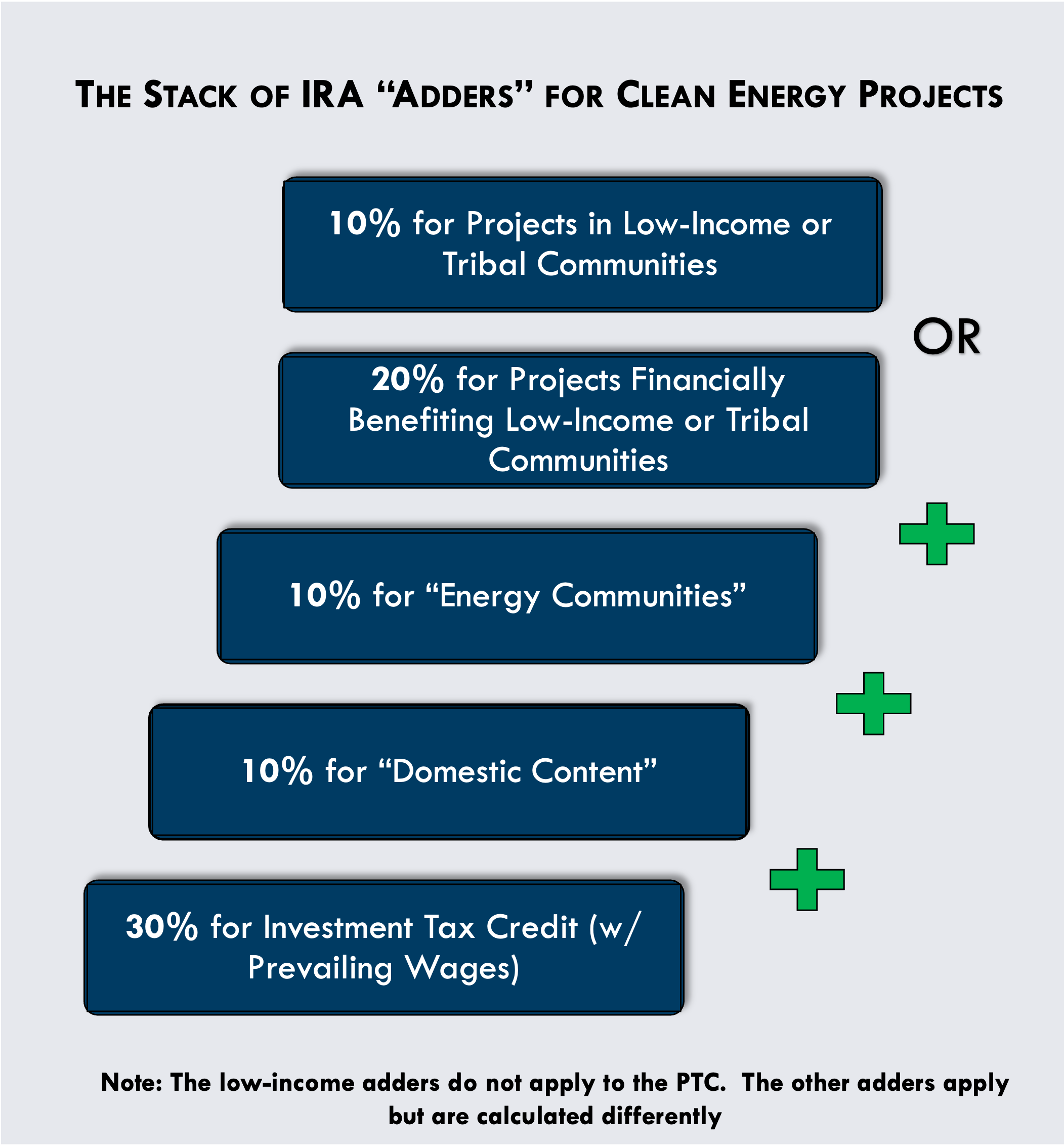
Federal clean energy tax credits may offer additional value enhancements (“adders”) when projects meet specific location, sourcing, or structural criteria. These adders build on the ITC and PTC and may align with your city’s broader reasons for buying renewable energy as part of your local energy transition.  These enhancements are not automatic and must be actively pursued. They are conditional, subject to eligibility rules, and in some cases competitive or capacity limited. When evaluating project economics, cities should assess whether pursuing an adder aligns with local goals, procurement flexibility, administrative capacity, and overall financial feasibility.

In addition to the definitions below, you can use this mapping tool to identify geographically-bound incentives. As noted previously, these credits expire for solar and wind energy projects after December 31, 2027.

Potential Credit Enhancements:


  • 1. Projects in Qualifying Low-Income or Tribal Areas

    Certain energy infrastructure projects located in qualifying low-income or Tribal areas may be eligible for additional credit value. These enhancements are typically subject to allocation processes and capacity limits. Projects must apply for and receive eligibility confirmation before claiming the enhancement.

  • 2. Projects Providing Direct Financial Benefits to Qualifying Communities

    Some projects may qualify for additional credit value if structured to deliver measurable financial benefits to qualifying households or Tribal communities (for example, through certain community solar or utility partnership models).

    Eligibility depends on program criteria and documentation requirements. In most cases, projects cannot combine multiple low-income–specific enhancements simultaneously.

  • 3. Energy Communities

    Projects located in certain areas associated with legacy fossil fuel activity, plant closures, or brownfield redevelopment may qualify for an additional credit enhancement.

    Eligibility is determined using federal geographic definitions that may evolve through administrative guidance. Cities should verify site eligibility before incorporating this enhancement into financial projections.

  • 4. Domestic Content

    Projects that meet domestic content requirements for steel, iron, and manufactured components may qualify for increased credit value.

    Meeting domestic content thresholds may require additional procurement documentation, supply chain verification, and contract structuring. These requirements can affect vendor selection, equipment costs, and project timelines.


Evaluating Tradeoffs

Credit enhancements may increase the potential value of federal tax credits—but they can also introduce additional cost, procurement constraints, compliance obligations, and administrative complexity.

For example:

  • Domestic content requirements may narrow supplier options or increase equipment costs.
  • Community-based benefit structures may require additional program design and reporting.
  • Location-based enhancements may limit siting flexibility.
  • Capacity-limited enhancements may require competitive application timing.

Cities should evaluate whether pursuing a specific enhancement strengthens overall project economics or introduces risks that outweigh potential financial benefit.

Where permitted by statute, some enhancements may be combined (“stacked”). However, stacking is conditional and subject to interaction rules and eligibility requirements.

Important Considerations

Eligibility thresholds, allocation limits, documentation requirements, and interaction rules for credit enhancements may change through federal guidance or legislation.

Before incorporating potential bonus values into financial models, cities should verify current eligibility criteria and assess compliance implications.

Top