Local Government:
City of Columbus, OhioProgram:
Clean Energy ColumbusCategory:
Aggregation, Off-Site Physical PPAProgram Purpose
Clean Energy Columbus, a community choice aggregation program approved by voters in 2020, enables the City of Columbus to contract for energy on behalf of residents and small businesses and provides 100% renewable energy through a portfolio of new solar and wind generation projects in Ohio. As of 2025, approximately 300 MW of renewable energy is already online or under development, with more projects planned to reach the long-term 700 MW goal.
Program Overview
In February 2020, City of Columbus Mayor Andrew J. Ginther announced the City’s commitment to pursue a 100% clean energy community choice aggregation (CCA) program to support local clean energy generation, create jobs, and help transition Columbus to a more sustainable economy.
There were multiple steps the City took to create a CCA, foremost being the need to acquire voter approval to implement a clean-energy-based CCA program. Beginning in July 2020, the City started holding virtual public hearings and presenting at neighborhood meetings to educate the community about CCAs and gather feedback.
In parallel to garnering community support and understanding, the City was also taking steps to ensure its readiness to move the program forward if it received voter approval. A CCA consultant, Trebel Energy, was hired in May 2020. In June 2020, the City launched a competitive bid process to identify a preferred supplier for the CCA, and the selection of AEP Energy was announced in August 2020. This demonstrated the City’s commitment to 100% Ohio-based clean energy and how it was possible to get there. In addition, starting in September 2020, an advisory group was convened to collect stakeholder feedback on the program throughout its design and development up until its ultimate launch.
In November 2020, the ballot question to create a CCA passed with 76% approval. Following approval, the City, Trebel Energy, and AEP Energy got to work on creating the Clean Energy Columbus (CEC) program and getting approval from the Public Utilities Commission of Ohio. Once fully implemented, CEC will be the largest electric aggregation in Ohio and one of the largest in the United States.
“Community choice aggregation and a commitment to 100% clean, renewable energy will transform our energy future and are key components to helping us achieve environmental justice and equity, so that all residents in central Ohio are protected from the impacts of climate change.”
City of Columbus Mayor Andrew J. Ginther
Columbus residents were given a choice to participate in the CEC program. Residents who do not want to participate are able to opt out. Those who did not opt out — about 80% of eligible residents and small businesses — started receiving 100% clean energy in June 2021 via a transitionary phase sourcing renewable energy certificates (RECs). This system will be in place until the 700 MW of Ohio wind and solar assets are constructed and operational. As of 2025, the program supports over 300 MW of active clean energy capacity and continues to add more projects in the state.

By providing Ohio-based clean energy through the construction and maintenance of new wind and solar assets, the program will support nearly 4,500 jobs in Ohio. Additionally, the CEC program is helping the City reinvest in communities impacted most by climate change through a community grant included in the program rate. The City has leveraged those funds to invest in a BIPOC-focused, youth-oriented clean energy jobs program and in low-income residential energy efficiency efforts to reduce energy burden.
Clean Energy Columbus serves over 212,000 residents and has saved participants more than $57 million compared to the baseline utility rate. The program continues to be one of the largest electric aggregations in the U.S., ranking 4th in CCA green power sales and 10th in CCA green power customers in 2023.
How is the program structured?
Resident participation in the CEC program is voluntary, and they can opt out at any time without fees or penalties. CEC program participants still receive one bill for transmission, distribution, and generation from AEP Ohio. The CEC program covers the generation portion of the bill, with the 100% clean energy supplied by AEP Energy. The City of Columbus and Trebel Energy work directly with AEP Energy as a team to manage the program.
“Electric aggregation is essentially collective bargaining for energy purchasing. Using this power we have a huge opportunity to provide competitive electricity rates, move towards 100% renewable energy sources and help support clean energy jobs in our region.”
Columbus City Councilmember Rob Dorans
What were Columbus’ biggest challenges in setting up this program?
Educating community members about aggregation: One of the biggest challenges was communications, including how to impart understanding of the aggregation process and relevant clean energy and climate benefits. Whether residents or organizational stakeholders, many people don’t understand how energy works or the various components that are reflected on an energy bill. Providing basic information and education on this, the aggregation process, and the climate benefits to impart understanding can be challenging as these are complex topics that need to be distilled to be as simple as possible to communicate.
Managing expectations and timelines: Launching the aggregation program required coordinating multiple steps. At the same time, the City had to explain why the initial power supply would rely on RECs before new solar and wind projects came online. Managing expectations and timelines—especially as residents asked, “Where is my clean energy coming from?”—was a challenge.
Aligning partners: Establishing a clean-energy-focused aggregation program requires collaborating with multiple partners, organizations, and residents who may have different priorities. While this can be a challenge, the City of Columbus has a rich history of working collaboratively across sectors to achieve success.
What advice would Columbus give other local governments as they pursue climate action projects?
- Set clear, bold goals: Having a clear, bold, time-bound goal for a 100% clean energy aggregation program by 2022 was critical to bringing all partners to the table, aligning everyone, and creating excitement and enthusiasm from residents and stakeholders.
- Build a multidisciplinary team: Success required collaboration between the City, consultants, utility partners, and workforce development staff—each bringing a distinct strength.
- Transparency and engagement are key: Throughout the process, the City engaged with communities by sharing information, providing updates, and getting advisory group reaction and feedback. Every step and decision the City made was publicly available and clearly outlined. Transparency, information sharing, and imparting understanding is particularly important to build trust with residents.
- Design for flexibility: Program design should allow for adaptation over time—whether in supplier contracts, reinvestment strategies, or metrics for success.
- Design with long-term equity in mind: From the start, Columbus built equity into the structure of the program—e.g., including a community grant in the aggregation rate and forming a Clean Energy Workforce Committee to guide reinvestment. This early planning enabled the City to move quickly once funds became available.
- Use procurement strategically: Columbus issued a Request for Supplier Qualifications (RFSQ), rather than lowest-cost bidding, to prioritize suppliers committed to reinvestment. This approach helped secure a supplier aligned with the City’s equity and climate goals and enabled long-term community reinvestment and public trust.
How does this project fit into Columbus’s broader climate and community goals?
Roughly $1 million per year is generated through the community grant fund, with over $500,000 already invested in local projects. These include youth-focused clean energy education, neighborhood-based initiatives, and targeted support for historically underserved populations. For example, the City works with Solar United Neighbors on a Low-to-Moderate Income Solar Co-Op pilot, which provides rooftop solar and battery backup to qualifying households. The City has also distributed energy efficiency kits to residents with high energy burdens in partnership with its supplier.
An additional $300,000 annually supports workforce development, jointly managed by AEP and the City. These funds supported the EMPOWERED! Program, which trains young people from communities of color and low-income and women for jobs in clean energy. This program has graduated 97 participants and placed them with employer partners, including Illuminate USA, Connect Housing Blocks, and AEP Energy. In 2025, the Clean Energy Workforce Committee hosted three Clean Energy Career Discovery events and approved nearly $600,000 for workforce training programs in Opportunity Neighborhoods.

Beyond Aggregation: Columbus’ Broader Clean Energy Efforts
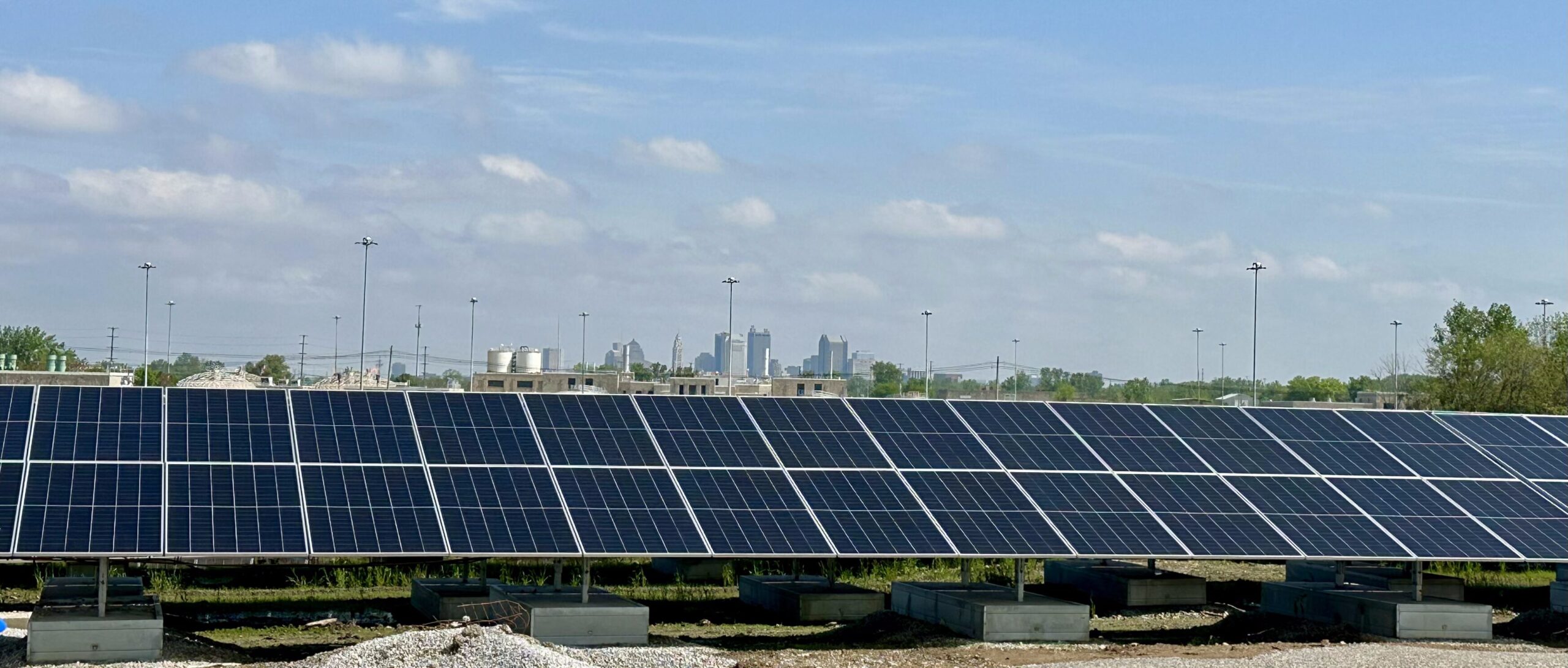
In addition to the aggregation program, the City is advancing other clean energy efforts to meet its climate goals. A key example is the 18 MW Jackson Pike solar project on a closed municipal landfill, part of a growing trend of reactivating closed landfills and brownfields with clean energy. Led by the Department of Public Utilities’ Division of Power and developed with NextEra Energy, the project transforms previously unusable land into a productive solar site that generates local clean electricity and integrates a native seed mix to support bees and other pollinators around the periphery of the solar farm.
The City is also building a 27 MW solar project on Parsons Avenue. Together, these two projects will power nearly 7,500 homes and increase the Division of Power’s clean energy mix to nearly 60%. While the Jackson Pike and Parsons Avenue projects are not part of Columbus’ aggregation program, they directly support the City’s goal of using 100% renewable energy for municipal operations. By putting unused land back to work, the City is showing how public land—including old landfills—can be part of the clean energy transition.
Additional Information and Resources
- Mayor Andrew Ginther’s 2020 State of the City Address (City of Columbus Mayor address)
- Mayor Ginther, City and Partners Kick-Off Community Choice Aggregation (City of Columbus press release)
- Columbus Residents to Begin Receiving 100% Clean Energy in June (City of Columbus press release)
- Mayor Ginther and Community Partners Announce Details for New Solar Park (City of Columbus press release)
- Sustainable Columbus (City of Columbus initiative)
- Columbus Climate Action Plan (City of Columbus plan)
- Aggregation Advisory Group Info (City of Columbus CEC page)
- Clean Energy Columbus (City of Columbus CEC program)
- Columbus Voters to Decide Green-Energy Aggregation Plan (Columbus Dispatch news article)
- City Leaders Announce New Program to Boost Hiring in the Clean-Energy Sector (WBNS news article and clip)
- The Future of Landfills is Bright (RMI report about landfill solar)
This project was included on the Renewables Accelerator’s list: 10 of the Most Noteworthy Local Government Renewables Deals of 2021.