

Local Government:
Austin, TexasProject:
Multi-Site Municipal SolarCategory:
Aggregation, On-Site SolarProject Purpose
To cost-effectively deploy at least 30 megawatts (MW-ac) of solar across an estimated 100 city rooftops and parking facilities, deploy shade structures to cool people and vehicles, and reduce air pollution.
Project Overview
In April 2026, the City of Austin approved two contracts to deploy at least 30 MW of solar across City-owned facilities. This is roughly the equivalent electricity consumption of 7,500 Austin households. By bundling its own assets into a single request for proposals (RFP) in December 2025, the City was able to both attract and achieve efficiencies of scale for solar deployment. This translates directly into better project value and streamlines planning and procurement — far more cost- and time-efficient than pursuing sites individually or on a department-by-department basis.
This approach will enable the City to capture multiple benefits beyond local energy generation:
- Cost Savings:
- The City estimates that the project will yield a positive net present value of at least $20 million in savings over the 25-year project lifetime. This investment is an innovative use of taxpayer dollars, intends to leverage low-interest financing from the Texas State Energy Conservation Office, and includes all upfront, operations, and maintenance costs. These savings result from embracing both city-owned and third-party-owned models. For the city-owned solar, Austin Energy will pay the City its Value of Solar rate. For the other sites, the City will receive lease revenue from the third-party developer for use of the rooftops and parking facilities. This revenue source is based on Austin Energy’s innovative Solar Standard Offer program, which pays developers for local solar installed at a fixed rate.
- Shade & Weather Protection:
- The City expects at least 30 sites will include solar canopies on parking lots, garage rooftops, and over recreational facilities. This will help keep people and vehicles cooler, protect parked vehicles from hail, and help reflect sunlight to reduce heat islands over asphalt surfaces. (Note: modern solar panels are certified to handle hail, though particularly severe hailstorms may cause some damage.)
- Investing in Regional Small Businesses & Local Workforce Training:
- Austin selected two Texas-based solar development firms, Big Sun Solar (for city-owned solar) and PowerFin (for third-party-owned solar), with local and regional employees. Both have agreed to a Work Site Agreement and have committed to using local labor paying prevailing wages and supporting job training and apprenticeship programs.
This procurement is notable for both its size and speed. It is the largest municipal multi-site on-site solar procurement in Texas and, by both number of sites and megawatt capacity, one of the largest in the country. At the same time, the City and Austin Energy executed their planning and procurement processes on a very short timeline, with only 10 months from project launch to contract award, demonstrating what’s possible with a focused, goal-oriented, whole-of-government approach. The City expects construction to begin less than a year from when the planning process started.
“This is a massive win for our community… By investing in solar across City facilities, we are not only reducing emissions — we are demonstrating what it looks like for a city to lead by example and invest in a cleaner, more resilient future.”
Zach Baumer, Director of Austin Climate Action and Resilience
What was Austin’s journey to get here?
In September 2021, Austin’s City Council adopted the Austin Climate Equity Plan. The primary goal was to reach community-wide net-zero greenhouse gas emissions by 2040. In 2025, the City of Austin Climate Action & Resilience then created a two-year Implementation Plan with 46 actions across various sectors, analyzing which interventions would have the highest emissions reductions per dollar invested. City staff determined that the second-most cost-effective action was adding solar on city facilities.
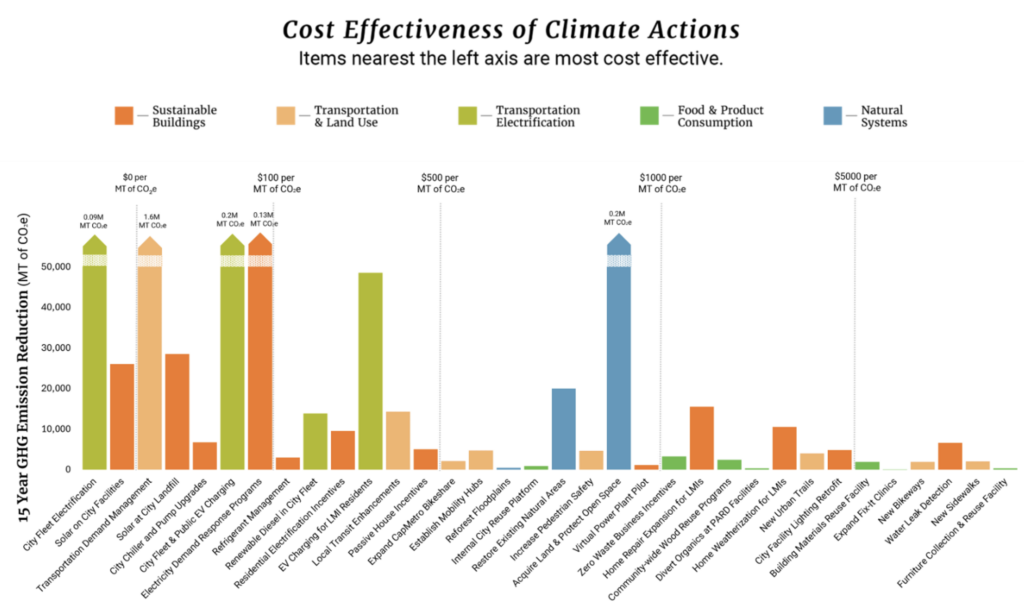
In spring 2025, the City Council selected “Install Rooftop Solar PV on City Facilities” from the Implementation Plan, and authored Resolution 20250522-052 to maximize the installation of solar on government-owned properties. As the City started to move forward, Congress passed H.R. 1, the “One Big Beautiful Bill Act,” on July 4, 2025. This federal policy change specifically accelerated the phase-out of the Investment Tax Credit (ITC) for solar and wind energy projects from 2035 to 2027, but projects commencing construction prior to July 4, 2026, could lock in a four-year construction window. This meant that the City had limited time to act to still capture these incentives.
With this tight timeline in mind, the City assembled its project team in summer 2025, comprised of senior staff from Climate Action and Resilience, Facilities Management, Financial Services, and Austin Energy, the City’s municipal utility. The City also contracted with RMI (founded as Rocky Mountain Institute), who had advised San Antonio on a similar multi-site project from 2021-2023, for assistance with site portfolio analysis, financial modeling, project management, and procurement planning.
“Not every facility will make the cut — and the project team understood that safety, operational, and future use needs would be key factors from the beginning. Hopefully, Austin’s undertaking is an example of how city architects and facility managers can bring their assets, data, and creativity to the table to be stewards of both citizen-owned facilities and the environment while generating revenue to offset operational expenses. It’s a win-win.”
Kit Johnson, City Architect, Austin Facilities Management
Over four months, the project team embarked on an ambitious planning effort to:
- Co-create a list of over 250 potential sites for solar with City departments, ultimately aligning on a portfolio of 110 sites;
- Draft a request for proposals (RFP) for market-based proposals based on the City’s priorities;
- Build a financial model to evaluate the net present value of proposals for both City-owned and third-party-owned proposals; and,
- Secure senior leadership approval to launch the procurement.
The City released the two-phased RFP in December 2025, first evaluating for qualifications and then, for shortlisted respondents, inviting and evaluating full pricing and technical proposals.

Why did you choose this procurement approach?
Encouraged by the proven success of San Antonio’s 2023 multi-site solar deal on 52 sites, Austin also decided to pursue a multi-site approach to capture the benefits of on-site solar at scale. Bundling many sites together creates economies of scale for a site portfolio. Plus, by avoiding individual site-by-site procurements, the City achieved greater administrative efficiency and attracted greater market competition.
By pursuing on-site solar at scale, with either ownership structure, the City and Austin Energy aimed to achieve multiple goals at once:
- Generate bill credits or lease payments, respectively reducing costs or generating revenue at each site.
- Increase Austin Energy’s grid resilience and flexibility while reducing power sector emissions with more renewable distributed energy resources.
- Spread benefits across Austin by utilizing existing rooftops, parking facilities, and recreational areas instead of greenfield land. This avoids interconnection queue delays and siting concerns associated with large solar farms.
- Enable opportunities for future pairing with energy storage and electric vehicle charging.
Lastly, the RFP allowed for three potential ownership models that could capture these benefits: city-owned, third-party-owned, and a hybrid of the two. With the city-owned model, the city would contract for solar developers to design, engineer, build, operate, and maintain a turnkey solar portfolio. The city would then directly receive the energy and bill savings from the energy generated and capture the Investment Tax Credit via Direct Pay. With the third-party-owned model, the developer would own the solar and receive payments from Austin Energy’s Solar Standard Offer Program while paying the City for the surface areas used. The developer would file for and claim the Investment Tax Credit and pass savings along through rent payments to the city for hosting the solar projects.
Note: While most utilities do not offer a program like Solar Standard Offer, other third-party ownership options exist in many states and regions, including power purchase agreements, equipment leases, and energy performance contracts.
“Having local generation on the distribution grid to serve customer energy needs reduces our electric demand on the broader ERCOT transmission grid, reducing costs to customers and congestion. Austin Energy is excited to support this effort to site a substantial amount of solar on City of Austin facilities—directly aligned with our Resource Generation Plan.”
TIM HARVEY, Director, Austin Energy Customer Renewable SOlutions
What were Austin’s biggest challenges in setting up this project?
Policy & Market Volatility: The City navigated multiple relevant federal policy changes and the knock-on solar market volatility. Such changes included Investment Tax Credit (ITC) deadlines by Congress in July 2025, commence construction guidance from the IRS in August 2025, evolving Domestic Content and Foreign Entity of Concern (FEOC) requirements that took effect at the end of 2025, and multiple tariffs.
Expedited Timeline Due to Federal Changes: Because of the accelerated ITC phase-out for solar, Austin risked not capturing the 30-40% federal tax credit if it didn’t realign its timeline to meet these new deadlines. The project team determined that meeting the July 4th, 2026, commence construction deadline was critical to set the project up for success with a longer construction timeline, though other cities face internal deadlines (i.e. budget cycles) and external deadlines (i.e. state and federal grant timelines) often as well.
Balancing Ambition and Capacity to Execute: Commendably, the City sought to make this effort as impactful as possible and capture the greatest economies of scale possible. However, this would not happen if the City could not assemble the operational and financial capacity to manage and pay for the project. This shaped the not-so-short list of 110 sites. For instance, sites with greater complexity or uncertainty were ultimately removed. This also motivated the City’s interest in City-owned, third-party-owned, and hybrid ownership approaches, so that it could consider multiple pathways.
A Whole-Of-Government Puzzle: With so many departments involved, the project leads had to align a large group of internal stakeholders and senior decision makers. The project required substantial data gathering, extensive coordination, and multiple approvals to proceed. Each request and decision point was both a necessary checkpoint and a high-stakes junction where delays could jeopardize the whole project.
What can other cities learn from how Austin prepared the solar market for this?
Austin’s ambition only mattered if there were qualified solar developers aware of and interested in this type of approach and timeline. Accordingly, the City took strategic steps to prime the market and receive responses from 15 interested firms.
Send Clear Market Signals: Due to the volatile policy landscape and expedited project timeline, the City realized that this would be a tight procurement process. Accordingly, once internal approvals were secured and while procurement and legal staff were finalizing the RFP, the City published an announcement on December 5, 2025, sharing its intent to issue an RFP later that month. An excerpt is below:
” The City of Austin… is preparing to issue a Request for Proposals (RFP) for a multi-site solar portfolio that will advance community-wide climate, sustainability, and clean energy goals… and is expected to offer over 100 pre-vetted City-owned rooftops, parking areas, and other areas for solar installations…The forthcoming RFP will likely be released in December 2025, and the City anticipates executing a contract by spring 2026…
This timeline is designed to ensure the project leverages available federal solar tax credits, supporting the City’s goal of expanding renewable energy while maximizing fiscal responsibility. This announcement is intended to allow prospective vendors to prepare and plan for a future submittal on an expedited timeline. The City is planning for a two-phased RFP, with the first phase evaluating respondents based on qualifications and the second phase evaluating pricing and technical approach…”
City of Austin Press Release, December 5, 2025
Communicating the intended project scale (over 100 City-owned sites) was essential for priming the solar developers best suited to deliver on the City’s goals. Beyond the explicit announcement, the message implicitly demonstrated the City’s seriousness of interest and understanding of market timing. And because the City knew it was planning a two-month turnaround through the winter holiday season, this announcement offered an extra week for prospective respondents to prepare staff and materials to respond.
Related, the City used a pre-proposal conference for each RFP phase to reinforce these messages, communicate the City’s review timeline, and set expectations early in the process.
Respect Prospective Partners: It is important to understand that Austin wasn’t trying to buy a solar panel; they were trying to contract with one or more partners for multiple years of work across the community. Every message and action the City took sent signals to prospective partners as to the type of partner the City itself would be.
- Using a two-phase procurement so that only qualified firms from Phase 1 would be asked to submit technical and pricing proposals for the large site portfolio offered;
- Sharing an initial site list with Phase 1 as a courtesy so that firms who expected to be short-listed could get a head start on their modeling and technical plans for Phase 2 (even though this didn’t include all site details);
- Sharing a robust spreadsheet of site-specific data for Phase 2 to reduce guesswork and follow-up questions, including site area, roof age, roof material, transformer capacity, and annual electricity consumption;
- Creating and requiring firms to use prepared templates for financial details and sites included to streamline parts of the City’s review process; and,
- Offering a longer timeline for Phase 2 technical proposals (~5 weeks) compared to the 3-week turnaround for Phase 1.
Most importantly, the City upheld its ambitious, internal timeline for Phase 1 and Phase 2 reviews, reciprocating the responsiveness, speed, and intensity that it expected from prospective private-sector partners.
This project moved from concept to contract in just 10 months. What lessons can other cities learn from Austin’s effort to move ambitious projects forward faster?
Secure Leadership Buy-In Early: To drive such a multi-faceted project to completion, it was critical for City staff to have buy-in from City Council and leadership across key departments, including Austin Energy. This enabled the project team to move nimbly and request timely data, preferences, and decisions.
Plan Proactively with Hard Deadlines in Mind: From early in the process, the project manager and technical advisors knew that this project would have to move quickly to hit key federal tax credit deadlines. Accordingly, a detailed project timeline was built, working back from when the City Council would have to approve and authorize a contract on this to allow for construction to begin by July 4, 2026. The timeline included specific scheduling blocks for city leadership review and the evaluation committee. The project team closely tracked progress against this timeline to keep the project on track and key milestones were hit, releasing the RFP within a week of the original plan. Other cities can learn from Austin’s tactical planning and market signaling efforts, which extend far beyond federal tax credit deadlines to budget cycles, bond issuances, state and federal grant cycles, and other factors.
Build a Cross-Functional Core Team: The City built an effective team to navigate this complex endeavor. From the start, this included facilities management, finance, procurement, and utility subject matter experts. With many challenging situations and decisions, the project team needed to include members who could understand, troubleshoot, and act on every aspect. The core team met weekly from July through April, creating a predictable cadence to surface issues early and often, make timely decisions, and avoid communication lags.
Including these functions and staff from the beginning was critical to project success. The Evaluation Committee also included staff from the aviation, parks, facilities management, and Austin Energy to include perspectives from staff across key departments ultimately impacted by the project. In fact, this project became an opportunity to embrace recent leadership direction to increase collaboration across departments — and may serve as a model for future projects.
Over-Communicate with Key Stakeholders: Even with a strong project team, many other stakeholders were involved in the project. The project team engaged early and often to avoid catching a key decisionmaker by surprise. This included conversations, information sharing, and even a “Solar 201” workshop for City departments. As circumstances evolved and the initiative advanced, the project team regularly shared updates to maintain alignment and understand questions as they arose.
“This project is a model of what is possible when a local government mobilizes rapidly. Thanks to leadership support and dedicated staff, we were able to collaborate on an extremely ambitious timeline to take advantage of a small window of opportunity. At the end of the day, we’ll reduce emissions, save money, and demonstrate leadership – all while providing shade, resilience, educational opportunities, and green jobs to Austinites.”
Rohan Lilauwala, Climate Project Manager, Austin Climate Action and Resilience
How does this project fit into Austin’s broader climate and community goals?
Austin is the 13th largest city in the United States by population and the capital of Texas. The City and its municipally owned utility, Austin Energy, have been leaders in renewable energy deployment and innovative customer programs.

This project directly advances multiple City and community goals. Going into this project, Austin had less than 1 MW of solar on city-owned facilities. By investing in on-site and city-hosted solar projects locally for City facilities, this deal substantially helps achieve net-zero community-wide emissions by 2040, as outlined in Austin’s Climate Equity Plan.
In April 2026, the City of Austin also approved an agreement for 8 MW of solar on 58 acres across the surface of a closed landfill. This approach leverages a very different type of City-owned facility. Once built, this will be the largest landfill solar project in Texas and the largest single-site solar project in Austin. The landfill solar project plus the multi-site deal directly contribute to Austin Energy’s goals of at least 205 MW of local solar energy by 2027, and at least 431 MW of installed local solar capacity by 2035 (including 160 MW of existing capacity).
The solar canopies planned over parking facilities and recreational areas prioritize shade for people, public parking, and employee parking. These canopies will complement broader heat island mitigation strategies, including tree planting, mapping heat islands across neighborhoods, and cool pavements. This is particularly valuable in a region vulnerable to increasingly extreme heat. Summer 2023 was Austin’s hottest on record, with more than 80 days hitting 100°F and 40 days surpassing 105°F.
Additional Information and Resources
- Solar on City Facilities: Solicitation Page
- Solar on City Facilities RFP (2025)
- Pre-Offer Conference Slides
- Press Release: City of Austin Here Comes the Sun: Austin to Expand Solar Across City Facilities
- Press Release: City of Austin Issues Multi-Site Solar Procurement RFP
- City Council Resolution for Solar on City Facilities
- Austin Energy Landfill Solar RFP Package (2025)
- Austin Climate Equity Plan
- Austin Climate Equity Plan: Implementation Dashboard